

The European Union is preparing the world's strictest legislation against deepfakes. As AI-generated videos reach realism levels that fool even experts, the EU is moving fast to set rules before the technology spirals out of control. What does this mean for citizens, companies, and freedom of expression?
📜 What the New Regulation Covers
The proposed regulation, known as the EU AI Act Extension on Synthetic Media, introduces mandatory labeling for all AI-generated content. Every video, image, or audio clip created or modified by AI must carry an invisible watermark and a visible “AI Generated” indicator. Social media platforms will be required to automatically detect and label such content.
The legislation introduces three risk categories: low (artistic deepfakes with labeling), medium (commercial use without clear disclosure), and high (political disinformation, pornographic exploitation). For the highest category, fines can reach €35 million or 7% of a company's global turnover.
🎭 Why Now? The Deepfake Explosion
The numbers are staggering. According to Europol, deepfake videos circulating online increased by 500% between 2024 and 2026. The majority (67%) involve non-consensual pornographic material, while 22% target politicians. The technology has reached a point where a convincing deepfake can be created on a smartphone in less than 10 minutes.
Across Europe, law enforcement agencies face escalating caseloads. Extortion using fake videos has become commonplace, and there have been multiple corporate fraud cases where deepfake CEO videos authorized multi-million-euro wire transfers. The urgency is clear — without regulation, the damage will only accelerate.

🔍 How Detection Will Work
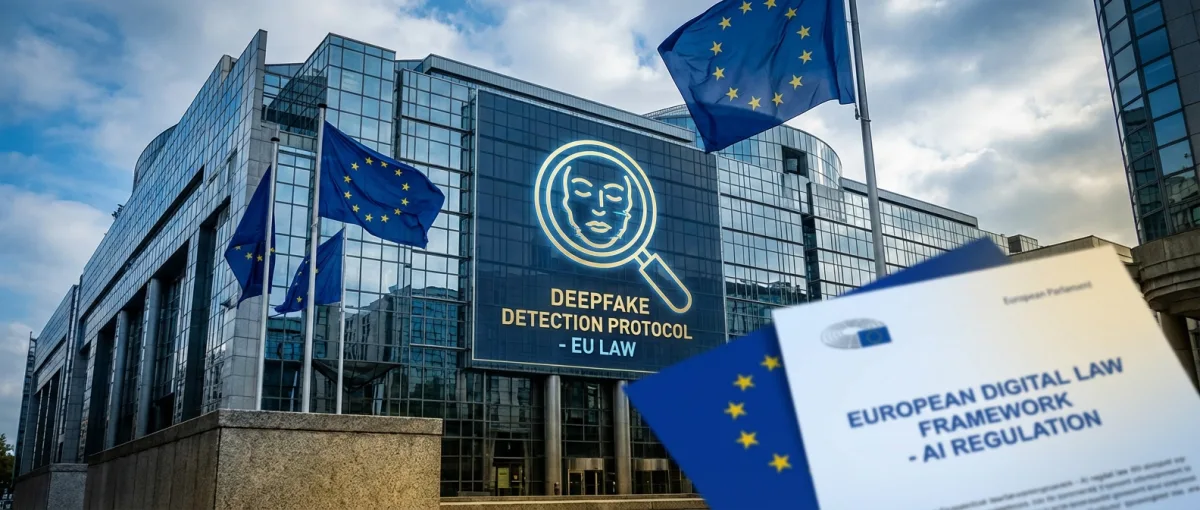
The EU is developing, in collaboration with research centers, a unified deepfake detection system: EU DeepDetect. It uses multiple techniques — lighting inconsistency analysis, unnatural facial movement detection, audio-video sync analysis, and forensic watermarking. The system will be open-source and freely available to platforms and journalists.
However, detection technology runs behind creation. New AI models can already produce deepfakes that fool most detection tools. That's why the law focuses more on mandatory labeling rather than detection alone — if labeling is deliberately removed, that constitutes a separate offense.
💡 Key point: The law doesn't ban deepfakes. It bans unlabeled deepfakes. The distinction is crucial: the EU recognizes the technology has legitimate uses (cinema, education, satire) but demands transparency.
⚖️ Criticism and Reactions
The legislation isn't without critics. Digital rights organizations worry that mandatory labeling could harm artists and satirical creators. Tech companies, meanwhile, consider the fines excessive. Meta has already made a closed-door presentation to the European Parliament opposing certain provisions.
On the other hand, victim organizations welcome the law. Pornographic exploitation through deepfakes, which predominantly affects women, will now be treated as a serious criminal offense across the entire EU, regardless of the perpetrator's country of origin. This closes a major legal loophole that many had exploited.
🌍 Global Implications
The EU's approach could become the global template, much as GDPR did for data privacy. Several countries, including South Korea, Canada, and Australia, are already studying the draft regulation. If adopted, it could establish the first international standard for synthetic media governance, potentially reshaping how AI-generated content is created and shared worldwide.